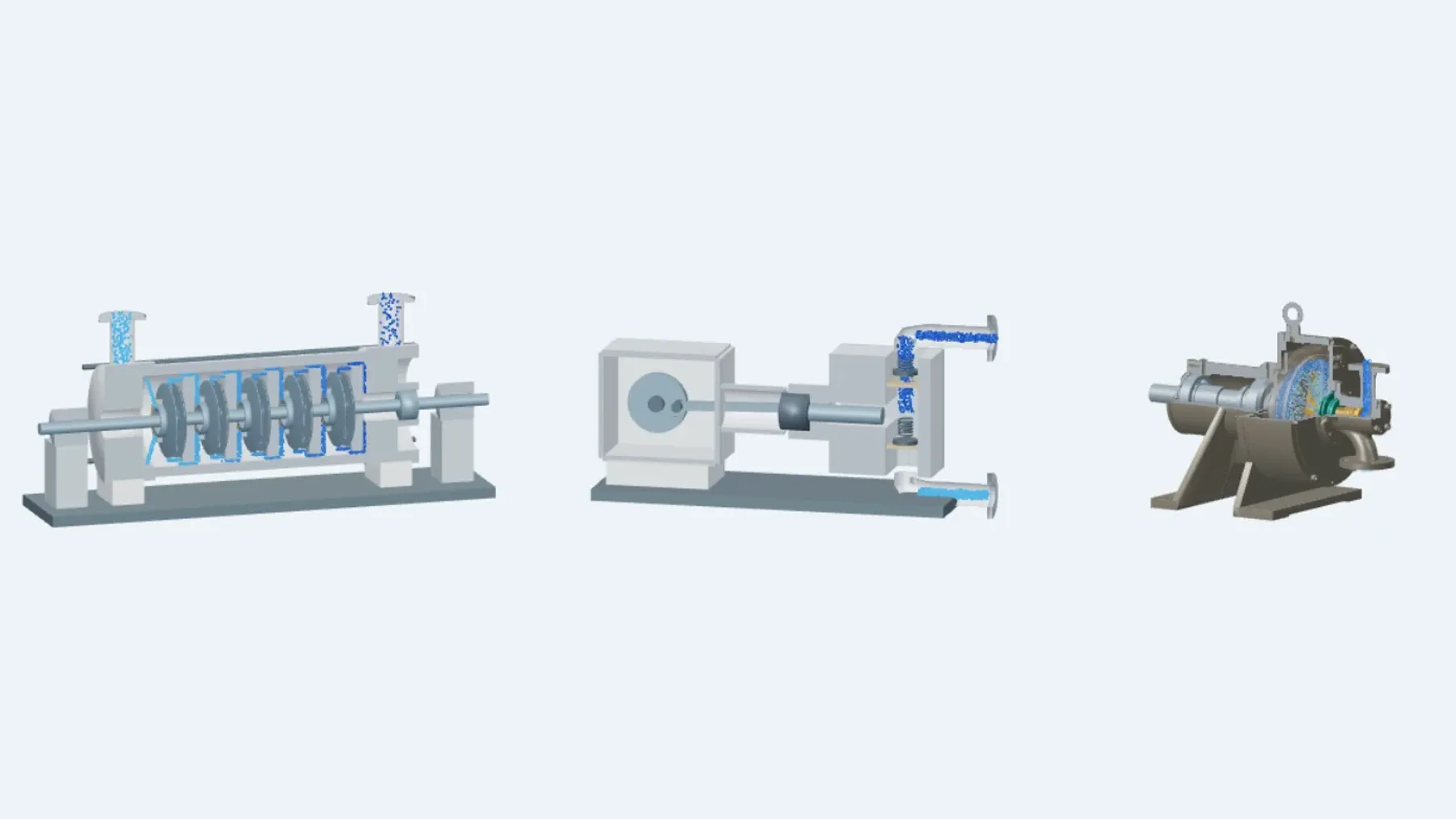
A multistage pump has several impellers in series on one shaft. Each stage adds part of the pressure. A higher head needs more stages, a longer rotor and more close clearances. At a very low flow, the pump runs far from its best efficiency point, with more recirculation, heat and vibration.
Plunger pump
A plunger pump builds pressure with back-and-forth strokes. The suction and discharge valves open and close on every stroke, so the liquid comes out in pulses. Plungers, packing and valves need regular replacement.
Pitot tube pump
A pitot tube pump has one stage. The rotor spins the liquid. A fixed pickup tube faces the moving liquid and turns its speed into pressure. One stage gives the full head, up to 1,050 m (3,445 ft) in the standard range. The delivery is continuous, with no valves or plungers in the liquid path. The mechanical seal is at the low-pressure inlet. It also pumps liquids that carry some gas or solid particles.
Side by side
Side by side: one stage instead of many, continuous delivery with no pulses, and steady running at low flow. The main wear parts are the pickup tube, the rotor, the mechanical seal and the bearings.
Kong 6 replacement record
At a PetroChina gas-field water station, an EHIK pump replaced a multistage pump. The motor went from 90 kW to 45 kW (121 to 60 hp). For the same volume of water, it used 39.5% less electricity.
When another pump fits
Above about 70–100 m³/h (308–440 US gpm), a multistage pump is usually the better fit. For higher pressures or exact dosing, choose a plunger pump or a metering pump.